Notting Hill architects
Topics: architects

As Notting Hill architects with extensive experience in conservation areas, we work with existing buildings, carefully interpreting local planning policy to create contemporary, liveable spaces that respect the character of the area’s historic buildings.
We are currently working on three projects in Notting Hill, including a Victorian terrace house on Elgin Crescent, and a large semi-detached Victorian Villa on Lansdowne Crescent both within the Ladbroke Conservation Area. At Pencombe Mews W11, we are refurbishing a modern mews house with high-quality contemporary finishes and joinery throughout.
Previously, we have completed a considered extension to a lower ground floor residential property in Kensington Park Road, demonstrating how a careful, context-led approach can unlock value in constrained urban homes.
This lower ground floor flat had been converted from a large Victorian house, within the Ladbroke Conservation Area. This part of Notting Hill is defined by its grand stucco-fronted villas, formal terraces and garden squares.
Architecture for London is an RIBA Chartered Practice. View our project portfolio, or if you would like to discuss improvements to your property, please contact us.
 Kensington Park Road front facade
The local Kensington and Chelsea planning policy is designed to preserve the Ladbroke Conservation Area’s historic townscape. Any alteration, however modest, must respond sensitively to this setting.
Design Brief: Adapting a Victorian Home for Modern Family Life
The flat required an extension to create a third bedroom so that it would be better suited to a growing family.
Architecture for London developed a compact and efficient plan that reconfigured the existing layout and introduced a new bedroom without resorting to an extensive basement excavation. The new room is proposed at the front of the property at semi-basement level, accessed via the original vaults beneath the entrance steps.
 Notting Hill architects: Kensington Park Road initial sketch plan
The semi-basement approach drops the new bedroom slightly below the existing lower ground floor level, reducing the impact of the extension when viewed from the street. This importantly creates new internal space that can be naturally lit and ventilated, something that is often difficult to achieve on a lower ground floor flat.
Carefully positioned windows and rooflights, combined with light-toned internal finishes, help bring daylight deep into the plan.
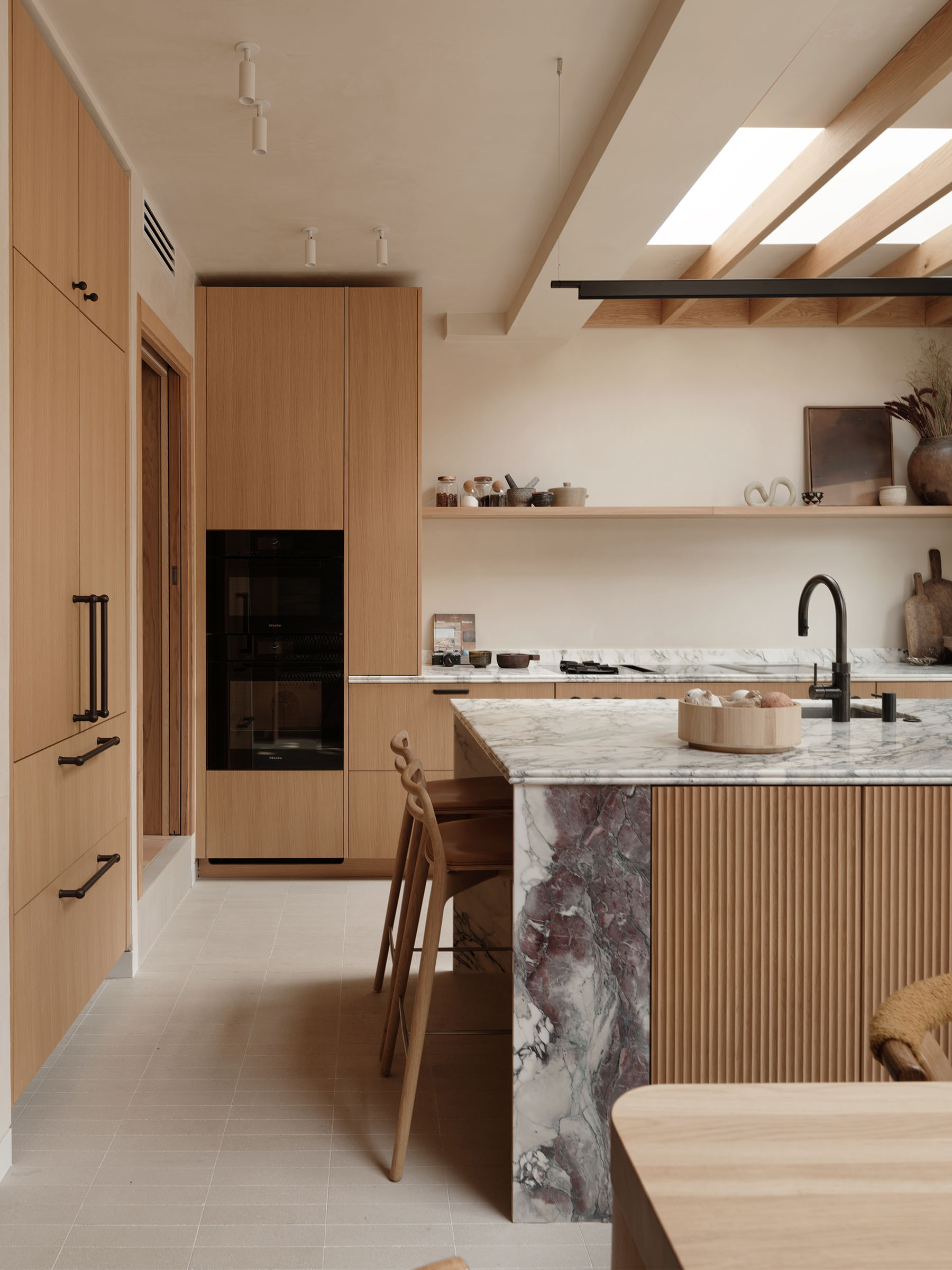 Notting Hill architects: Our kitchen extension in a neo-Georgian property
Kitchen Reconfiguration and Improved Internal Layout
The kitchen is redesigned and relocated to better connect it to the reception room, reflecting the client’s brief for sociable, open-plan living. Sliding doors allow the kitchen to be concealed when required, offering flexibility between a calm, formal reception space and a more functional family room.
By moving the kitchen, the design frees up the original vault for a new utility room and much-needed additional storage. These spaces are essential for family life but are often missing in converted Victorian flats. Integrating them discretely within the existing structure preserves the scale of the living spaces while improving day-to-day functionality.
 Kensington Park Road: detailed cross section through rear extension
Avoiding a Full Basement Extension
A more extensive basement extension to the rear was explored but ultimately avoided due to cost, disruption and structural complexity. Deep excavation would have required challenging access, significant steelwork and underpinning to carry the load of the four storeys above.
As architects working regularly in Notting Hill and Kensington, we understand local market expectations, buildability issues on tight urban sites, and the scrutiny that major basement schemes attract from both neighbours and planning officers. In this case, a more modest, carefully considered intervention delivered the required accommodation with less risk, less cost, and greater planning certainty.
 Kensington Park Road: front cross-section and elevation
Working with local Planning Policy and Conservation Constraints
The property lies within the Ladbroke Conservation Area, a largely residential neighbourhood in the northern part of the Royal Borough of Kensington and Chelsea. Local planning policy places strong emphasis on:
- Preserving original façades, railings and boundary treatments
- Maintaining front lightwells and the historic relationship between pavement and basement level
- Protecting the setting of listed buildings and the wider townscape
- Controlling basement works where they may affect structural stability, drainage or the character of gardens and rear elevations
Our scheme responds directly to these priorities: street-facing changes are subtle and largely below eye level; structural intervention is kept to a minimum; and the external appearance of the building remains consistent with neighbouring properties. Early dialogue with planning officers and a clear, policy-led justification were key to securing consent.
 Our living room in a neo-Georgian property
Architects in Notting Hill: Local Architectural Character
Notting Hill is known for its distinctive mix of:
- Stucco-fronted Victorian terraces and villas
- Formal crescents and garden squares
- Painted townhouses and mews streets behind the main avenues
- A rich layering of later infill and conversion work
For architects in Notting Hill, the challenge is to introduce modern interventions – improved insulation, services, open-plan layouts and additional bedrooms – while retaining the elegant proportions, cornices and sash windows that are often found in houses in the area.
In this project, Architecture for London’s approach was to work with the existing structure rather than against it: utilising redundant vaults, making efficient use of volume at semi-basement level, and preserving the main reception room as a generously scaled, light-filled space.
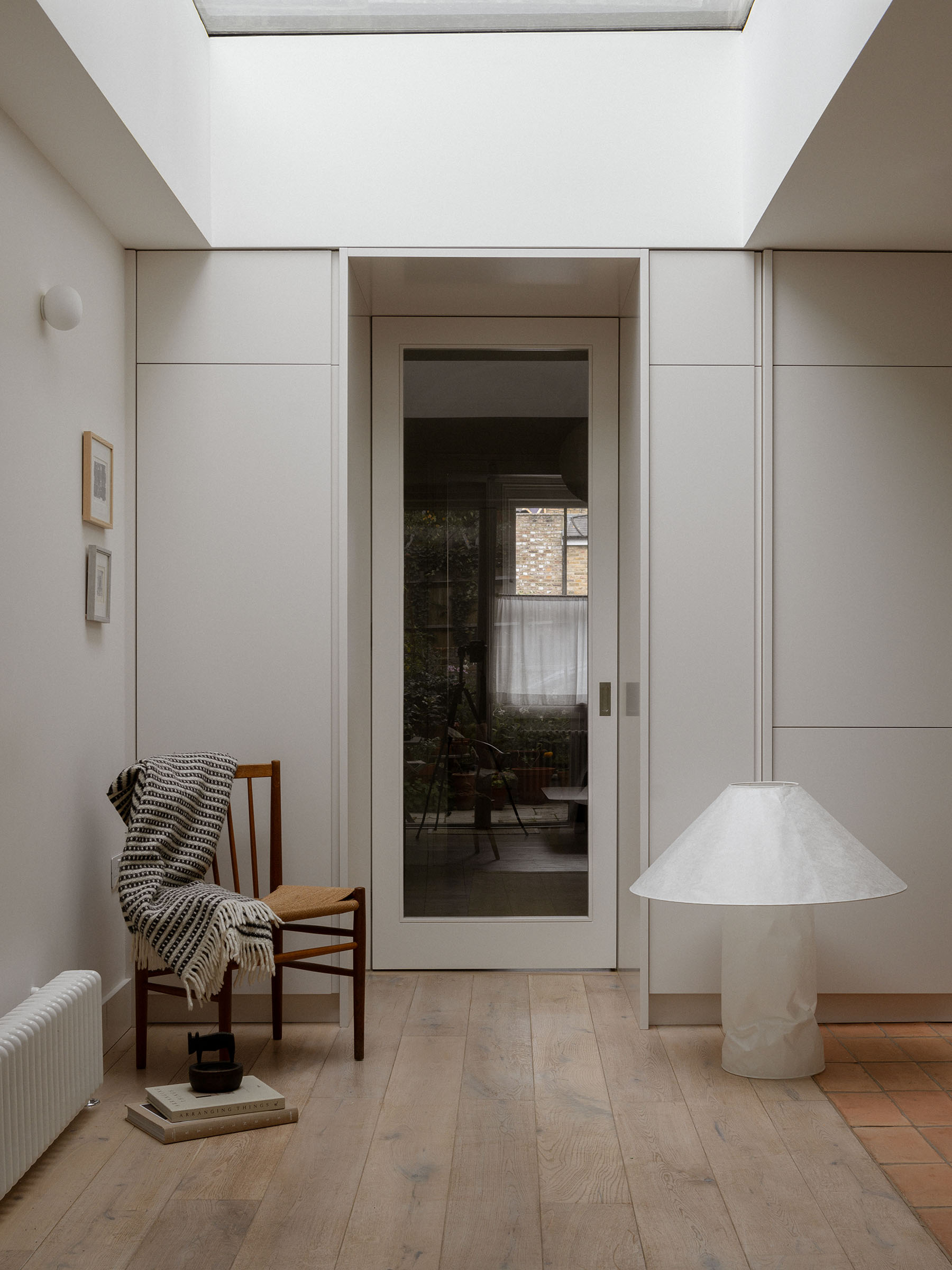 Architecture for London’s rear extension to a Victorian property
Notting Hill Architects with Conservation Expertise
Architecture for London specialises in contemporary homes within historic contexts, with a particular focus on prime London neighbourhoods such as Notting Hill, Westminster and Kensington. Our work ranges from modest internal reconfigurations to full-house refurbishments and carefully considered extensions.
On this Kensington Park Road project, our role included producing feasibility studies and developing the planning strategy. We also produced the detailed design package and coordinated with structural engineers and specialist contractors. The result is a practical and elegant solution that transforms a Notting Hill flat into a contemporary space for city living.
Project Information
Project architects: Ben Ridley, Matt McKenna
Location: Kensington Park Road, Notting Hill W11
If you are looking for Notting Hill architects to help with a flat alteration, house extension or refurbishment, Architecture for London can advise on feasibility, planning risk and design options specific to your street and conservation area.
Our residential portfolio includes completed homes across Kensington and Chelsea, demonstrating how sensitive, contemporary architecture can sit comfortably within London’s historic fabric. Visit the Architecture for London residential projects page to view our completed homes in the borough.
 The master bedroom in our neo-Georgian refurbishment